How Independent Artists Can Build Real Growth Around a Music Release
Discover how a structured music marketing campaign helps independent artists build real growth around a music release, using content, Meta advertising, and retargeting for sustained success.
Releasing a strong song is only one part of building a successful artist brand.
At AP Media, we approach music promotion as a staged growth campaign rather than a one-day announcement.
How Independent Artists Can Build Real Growth Around a Music Release
A common release strategy looks like this:
- The artist posts the artwork.
- A short video is uploaded on release day.
- The post receives some engagement from existing followers.
- Promotion slows down within several days.
- The artist starts again from zero for the next song.
The problem is not always the music. The problem is that there is no campaign infrastructure around it.
A stronger strategy builds awareness before release, increases campaign intensity around the launch, and continues using fresh content after the song is available. Consequently, this gives the music more opportunities to reach relevant listeners and also gives the artist more time to learn which messages, visuals, and audiences are responding effectively.
How Independent Artists Can Build Real Growth Around a Music Release Using the Artist-Growth Funnel
Paid advertising should not be treated as a machine that instantly creates fans. It works best as a controlled distribution system that introduces the artist to relevant people and records the audience signals created along the way.
A simplified artist-growth funnel may look like this:
- Relevant people see the artist or song.
- A portion of that audience watches the video or listens to the snippet.
- Some viewers visit the artist’s profile, engage or follow.
- Those interactions create a warmer audience that can be reached again.
- The strongest prospects take a higher-intent action, such as visiting a release link, watching the official video, following the artist or responding to a future event campaign.

The objective is not to force every person to act immediately. Instead, the objective is to identify and retain the people showing genuine interest.
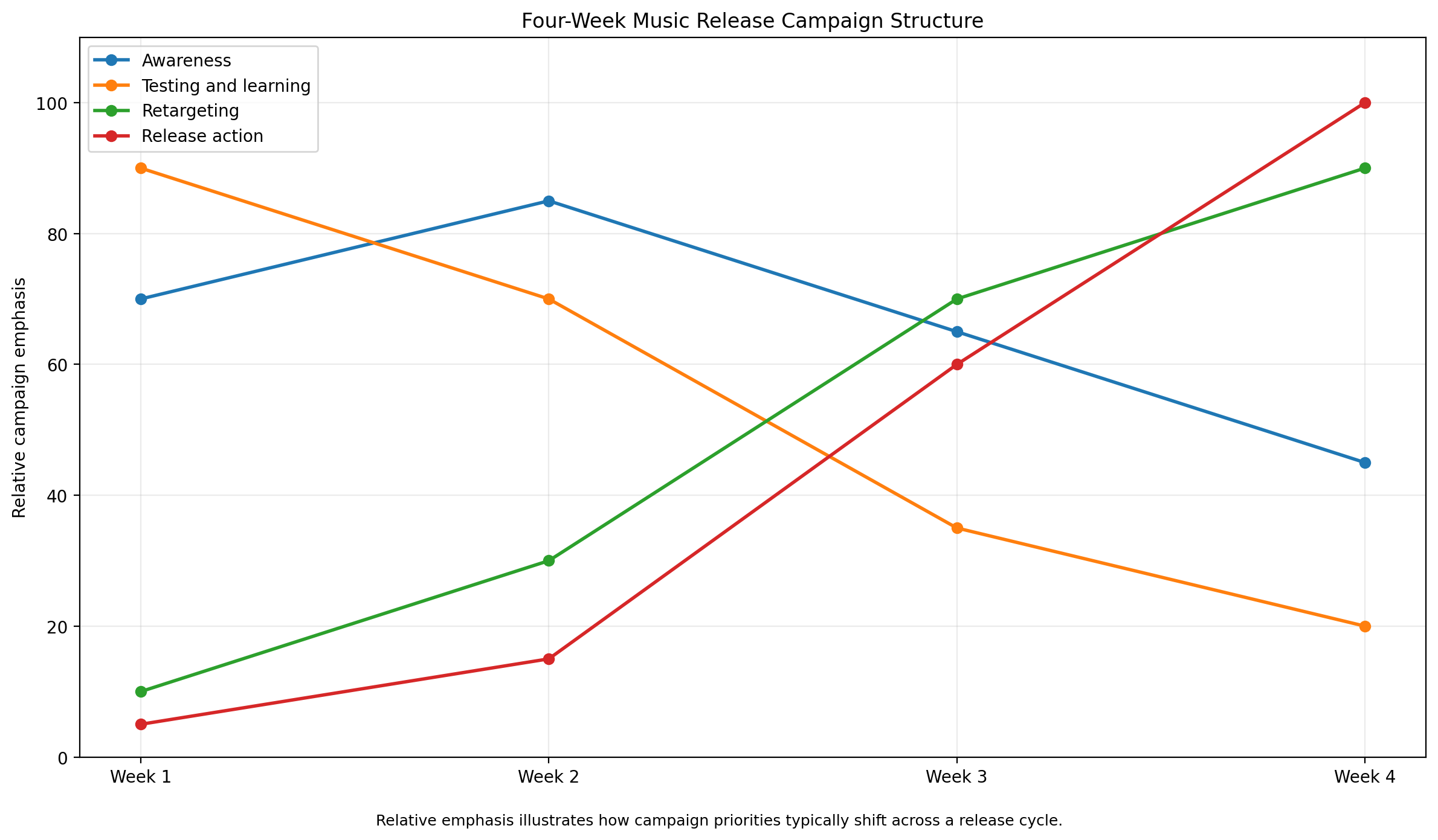
A three-phase music release strategy
Phase 1: Pre-release awareness and testing
The pre-release stage introduces the artist and begins testing what attracts attention.
Campaign assets may include:
- 15 to 30-second track snippets
- Artist-to-camera announcements
- Studio or behind-the-scenes footage
- A short explanation of the song’s meaning
- Cover artwork adapted for social placements
- Lyric-led edits
- Performance footage
- Multiple hooks from different parts of the track
The purpose is not simply to tell everyone that a song is coming. It is to discover which combination of creative, message and audience produces the strongest response.
One part of the song may generate better watch behaviour than another. For instance, an artist-led story might outperform polished artwork. Similarly, a raw studio clip could create more comments and profile visits than a formal promotional video.
Testing these variables before release provides useful information for the launch period.
Phase 2: Countdown and release activation
As the release approaches, the campaign begins shifting from introduction to action.
People who watched videos, engaged with posts, or visited the artist’s social presence can receive stronger release messaging. Since this audience already has some familiarity with the artist, the campaign does not need to introduce the entire story again.
Release-period messaging may focus on:
- The official release date
- The strongest track hook
- The official listening destination
- A music video or visualiser
- Listener reactions
- The meaning behind the song
- Clear follow, watch or listen calls to action
Budget should be moved toward the creative and audiences that generated the strongest quality signals during testing.
Phase 3: Post-release growth
Release day should be treated as the middle of the campaign, not the end.
After launch, artists can keep promoting the song using new ideas:
- Lyric breakdowns
- Fan or listener reactions
- Behind-the-scenes content
- Live performance clips
- The artist discussing the writing process
- Alternate edits of the strongest hook
- Music-video teasers
- Short-form vertical content
- Performance or event announcements connected to the release
This extends the track's commercial life and gives the artist more chances to turn attention into social growth.
Content is the fuel of the campaign
Advertising cannot compensate indefinitely for weak or repetitive creative.
A productive campaign needs enough content variation to test different reasons for someone to care about the artist. The campaign should not rely on one piece of artwork or one long video.
A practical content library can include:
- High-resolution cover artwork
- Several short vertical track snippets
- Artist-led story videos
- Studio footage
- Live or performance footage
- Release countdowns
- Listener reactions
- Lyrics or captions on screen
- Music-video previews
- Short edits made specifically for Reels and Stories
The opening one to three seconds are particularly important because, at this point, the creative must quickly communicate sound, personality, emotion, or visual interest to capture attention.

A balanced campaign generally tests more than one content category:
- Track snippets and performance content create direct exposure to the music.
- Artist-led storytelling gives people a reason to connect with the person behind the track.
- Reactions and social proof show how other listeners respond.
- Artwork and countdown content reinforce recognition and timing.
Turning one listening session into a content engine
A listening session can be more than a private playback.
With proper direction, a short session can generate multiple pieces of campaign content. The artist can play the track for a small group, capture immediate reactions and record short responses about the mood, lyrics or strongest section.
The session may produce:
- First-reaction clips
- Short listener testimonials
- Artist interviews
- Song-story content
- Behind-the-scenes footage
- Social proof advertisements
- Release-week Reels
- Post-release reaction edits
This makes the session a content-production asset that supports both paid and organic marketing.
How Meta advertising supports artist growth
Facebook and Instagram advertising can place artist content in front of people beyond the existing follower base.
Core music-interest audiences
These audiences are built around relevant genres, music culture, discovery behaviour and comparable interests. They are useful for initial testing but should not be treated as perfectly precise fan groups.
Geographic audiences
Location targeting can be aligned with the artist’s goals. A campaign may focus on a city, state, country or selected market depending on where the artist wants to build listeners, bookings or event demand.
Engagement audiences
People who interact with the artist’s Facebook or Instagram content can become a warmer campaign segment.
Video-view audiences
People who watch a meaningful portion of a track snippet or artist video may show stronger interest than people who simply received an impression.
Retargeting audiences
Retargeting allows the campaign to reach previous viewers and engagers with a more direct message about the official release, video, show or next piece of content.
Broader expansion audiences
Broader targeting can be tested once the campaign has effective creative and enough response data. Strong creative often gives the advertising system better information about the type of person likely to engage.
Why limited budgets should not be fragmented
Independent artists rarely have unlimited advertising budgets.
A common mistake is dividing a modest budget across too many audiences, placements, objectives and creative variations. Each test then receives too little delivery to produce useful information.
A better account structure is usually simpler:
- A small number of clearly defined audience tests
- Several strong creative variations
- One clear objective for each campaign stage
- Enough budget for each test to generate meaningful delivery
- Regular review and reallocation
Complexity does not automatically produce better performance. A controlled campaign with clear learning goals is more valuable than an oversized account structure that cannot collect sufficient data.
What should be measured?
Impressions alone should not determine the success of an artist campaign.
Reach and frequency
How many relevant people did the campaign reach, and how often did they see it?
Video watch behaviour
Did people stop and consume enough of the creative to indicate interest?
Cost per campaign result
How efficiently did the campaign generate its selected outcome, such as video views, engagement, or traffic?
Engagement quality
Shares, saves, comments, and meaningful reactions provide stronger signals than passive likes.
Profile activity
Did the campaign direct visits to the artist’s Instagram or Facebook presence? Did visible follower activity increase during the campaign?
Retargeting audience growth
How many viewers and engagers became reachable for future promotion?
Creative learning
Which hook, format, message, or artist story performed most effectively?
Release response
Did the warm audience engage with the official release content, video, or listening destination?
No single metric tells the whole story. Therefore, evaluate performance through a combination of exposure, attention quality, social activity, and audience development.
Real artist growth versus artificial numbers
Buying fake followers, streams, views, or engagement might make an account look bigger for a while, but it doesn't create a real audience.
Fake activity can mess up campaign data, lower engagement quality, and make it harder to tell if real people are responding to the music.
A proper growth strategy focuses on:
- Real paid distribution
- Great creative content
- Testing with the right audiences
- Clear reporting
- Building audiences you can use again
- Consistent content
- Long-term brand positioning
There are no guaranteed follower or streaming numbers. Results depend on the song's quality, the content, how the artist is presented, the advertising budget, market competition, platform delivery, and the overall release execution.
How AP Media can help build an independent artist
AP Media can manage the strategic and technical work required to turn a release into an organised growth campaign.
Campaign strategy
We define the campaign objective, release phases, audience journey, budget allocation, key messages and conversion path.
Meta campaign setup
We build and manage the campaign structure across Facebook and Instagram, including campaigns, audiences, advertisements and account connections.
Audience research
We develop relevant location, genre, interest, engagement, video-view and retargeting audiences aligned with the artist’s direction.
Creative direction
We review the artist’s available footage and advise which hooks, formats, stories and messages should be prioritised.
Advertising copy
We prepare primary text, headlines, calls to action, countdown messaging and release-focused copy.
Testing and optimisation
We test creative and audiences, monitor delivery, reduce waste and move budget toward stronger combinations when sufficient data is available.
Retargeting
We build warmer audience groups from video viewers and social engagers, allowing the artist to promote the release, music video, performance or next campaign to people who already showed interest.
Reporting and consultation
We provide clear performance summaries, campaign learnings, decisions made and practical recommendations for the next content or growth action.
Optional content production
Where required, AP Media can also scope creative direction, filming, listening-session production, short-form editing, artwork support or landing-page development as additional services.
What a four-week artist campaign can achieve
A properly managed campaign should produce more than a temporary increase in exposure.
At the end of the campaign, the artist should have:
- Greater awareness around the release
- A clearer understanding of the strongest content
- Better information about responsive audiences
- A larger pool of video viewers and engagers
- Creative assets they can reuse
- A structured post-release plan
- A stronger foundation for the next video, performance, or single
The most valuable outcome is a repeatable system.
Each campaign should make the next campaign more informed. The artist learns what people respond to, the advertising account develops useful audience signals, and AP Media can use those insights to improve future promotion.
Build an audience that lasts beyond release day
Independent artists do not need to rely on one viral moment.
A disciplined combination of content, paid distribution, testing, retargeting, and consistent release activity can help independent artists build real growth around a music release. AP Media assists artists in creating that structure—transforming individual songs into connected campaigns and converting fleeting attention into long-term growth assets.
Planning a new single, music video or artist campaign?
Speak with AP Media about building a structured promotion strategy across content, Meta advertising, audience growth and performance reporting.

AP Media
Creative. Marketing. Growth. — Sydney's premium growth engine for local businesses.
Ready to grow your business?
We build premium websites, run high-performing Meta Ads, and rank you at the top of Google and AI search. Let's talk about your growth plan.